Senin, 31 Januari 2011

Looks Like We're Right on Trend for 2011

I had to laugh when I saw this photo in the January Issue of House and Home
Photography by Eric Boman
They call this trend "The New Vintage". 
 "No need to worry about scratches or dents -- this look is very forgiving." 

Chipped paint on the baseboards and door casings? Check.
Dingy and yellowed crown molding? Check.
Mismatched wood floors? Check. 
Out of style wallpaper? Check.
Furniture that looks like it has been found on the side of the road (thanks to two little shih tzu's named Harry and Georgia)? Check. Check. Check.

Seems that Chris and I can cross a few projects off our list without having to lift a paintbrush! 

Minggu, 30 Januari 2011

5 Reasons to have an accent wall

Should I have an accent wall? This is the most frequently asked  question that keeps popping up in conversation with clients.  Like every other decision made in design the answer depends on the room in question.

Contemporary and modern interiors can  lend themselves to accent walls.  Personally I'm not a great lover of accent walls except in very specific situations.  I do not have any in my own home. I feel there are more subtle ways to make a room inviting and interesting.  Accent walls that employ extreme colour contrasts are definitely not one of my loves, unless they are designed very skillfully, they visually unbalance a room especially when the room is small.

When should you think about using an accent wall in a room?
Here are basic guidelines to help you decide if and where you may want an accent wall:

1. To anchor or define a separate area within a larger space especially in open plan homes

The Neoteric Classic modern kitchen
  refined island designs


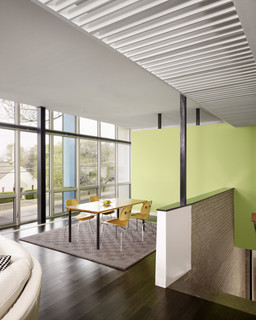
The value of the colour of the accent wall  is kept in check with the overall look of the room.  It isn't jarring but it does help to define the seating area. 

Alterstudio modern dining room
2.To highlight a large focal point on or near a wall


The addition of red/rose to the recessed areas of the wall further highlights the fireplace and creates a commanding focal area in a small room. The focal colour is well distributed around the room providing good colour balance.


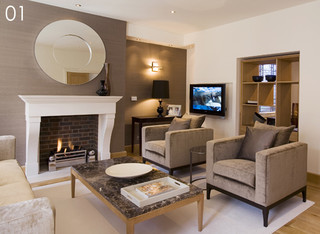
Interior re-design and interior re-designers-Blacksheep Design UK are residentia contemporary living room
The lighter taupe colour used to accent the firplace is soft and helps to focus the eye on the fireplace wall without overwhelming the overall quiet tone of this room.

3.To pull a viewer's eye through a room

 source

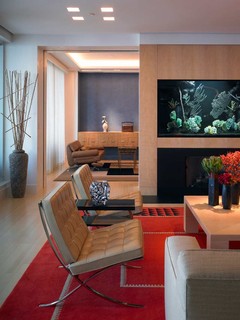
Your  eye automatically moves through this space to the opposite wall. The same effect could be achieved with a less intense colour though.  Why do so many people automatically use red on accent walls?  In small spaces intense warm colours  make the wall advance and shrink the space visually when you should be thinking about enlarging it.


In this room  your eye is caught by the red area rug initially but the use of the gray blue on the wall in the next room makes the space seem like it is going on forever. 


source

This is a skillful use of an accent wall to pull the viewer through the room .  It also highlight the door and the addition of the vertical metal wall art is perfect for the space. The red also pulls the accent colour through the room. 

4. To  visually change the proportions of a room - visually enlarge or shrink it

dining room  dining room
Houzz

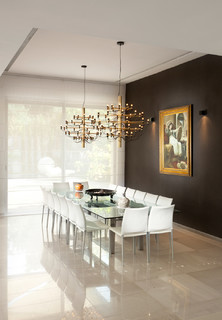
This large space is controlled by the use of the dark accent wall which anchors the space and also provides a backdrop for the dining table. 

highland park contemporary dining room

Long narrow rooms can usually take an accent wall which helps to visually shorten the space. The yellow in the artwork adds to this effect.

5.To provide a backdrop that frames a room's furniture arrangement (typically the first wall you see when you enter a room).


I love everything about this soft and inviting room.   The accent wall quietly does it job of focusing the eye and highlighting the minimal furniture arrangement. The three piece of art are a great finishing touch.

Aquamar Bathtub modern bathroom
PSCBATH
   
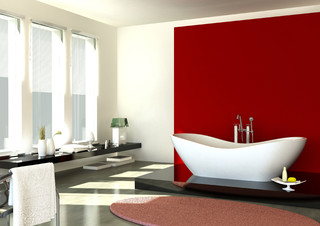
You certainly can't ignore this bathtub.  The splash of red that anchors it makes the room.


Then there are the accent walls that might have been better placed in a room or left out entirely because they cause confusion. As always , this is my humble opinion. 


If I were choosing a wall to accent in this room it would not be the back wall because it is  not the focal point in the room.  Everything points to the fireplace wall including the furniture arrangement. If you felt the far wall needed interest, a large piece of art or an arrangement of art work hung at viewing level would help bring this wall  back into the room.   


Are you a fan of accent walls?

Jumat, 28 Januari 2011

We're (sub) Floored!

I haven't had a chance to post on the bathroom work, so I'm stepping back a little bit....  first, Carrie mentioned the framing and expanding the casement ...  the existing framing as shown below was ok, and the beadboard is ~3/4" thick--  so the walls are already very solid.  What you see below required ripping the 2x4's down on my table saw, then notching with my jig saw.  Overall, it went quite well, but it was time consuming.  There are still pieces that need to be completed for the drywall. 


A tool purchase that helped a lot and I have been very pleased with is the palm nailer, by Rigid, that you can see below...  at around $70 at Home Depot, this thing is fantastic.  It runs off my small PC pancake compressor, and drove everything without the expense of a framing nailer nor the PSI needs.  Highly recommend it.... Also great for angles, toe nailing, etc.  this tool pays for itself quickly.  No problem to start a nail with a hammer and drive it home with this.


The next step has been the subfloor in the room.  While the wood is in OK shape, it has been through multiple bathroom configurations...  There are too many holes to salvage it.  Below, you can see some of my patchwork--   Overall, the floor was > 2" thick with wood + subfloor, which is good...  just needs a few patches.


After some effort and fitting the cement boards to size, it was time to add the thinset underneath the backer board.  I bought an $8 drill attachment for stirring the thinset.  Following the directions on the bag of mortar, it said to add water and then the thinset, but I think I should have done this gradually (I poured the whole bag in.)

Trying to mix the thinset strained the sh*t out of my favorite Rigid Power Drill (3/8".)   It is corded and there was smoke and some nasty fumes coming out from it--  Carrie complained of a headache for the rest of the day....  So I used the stirring attachment without power (think churning butter) but it wasn't perfect--  I didn't like the consistency of the thinset, it was a bit thick, but I think it was ok.


You can see below my scratch coat on the left, I used a drywall knife to lay this down.  On the right I am using my trowel... the ridge to the right of my hand was knocked down.  Farther to my right, you can see a 2x4 I cut down to prevent thinset from seeping and drying where the threshold will go inside the casement.


First layer of board down here...  a few screws in, but not the full allotment.  I wanted to lay the thinset efficiently.


Below I am on my second board ...  improving technique as I go, this is a nicer scratch coat.  If you are wondering about the white spots, that is linoleum adhesive I couldn't get up easily...  by easily, I mean without the use of a power tool or pliers and a blowtorch.  Everything I read online said to not bother with it if it is secured well to the floor.


This is a shot of my putting in the backer board screws every 8 inches....  I'm sure guys get used to it, but this work is really hard--  hunched over, time sensitive...  I have a tremendous amount of respect for guys that do this every day.  I used my Hitachi impact driver to do the floor screws, it worked great, although I did have to run to the basement to switch batteries...  no biggie.


With all three sections in, I placed some mesh tape on the seams and leveled them a bit.


Finished subfloor, still drying.  Screws have been placed every 8".


It is really important to me to give back a little bit....  This is me teaching Georgia how to cut backer board.  Once she realized fud wasn't involved she did pretty gud.


Selasa, 25 Januari 2011

What colour should I paint my entrance?

 When I am choosing colours for a specific space I usually have a set of  very loose guidelines that I consider  when making decisions. These guidelines are not hard and fast rules, rather they have been formed through various experiences and observations over the years.  If I were choosing a colour for an entrance (porch or foyer) here are some of the things I would consider :

The purpose of the space
A doorway serves as a transition from one state of existence to another and this transition can be marked in various ways.  One of the most common strategies is to use colour to reflect your invitation to enter your home. People often  choose a welcoming colour (red, yellow,  green etc. )  or a more stabilizing  colour (brown, black, gray) for their entry door.

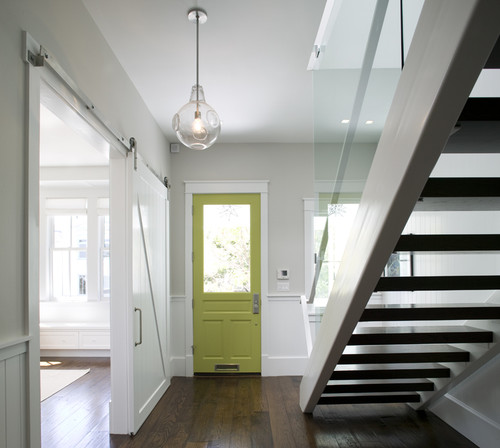
  When the door is opened that colour is brought  inside.  If it is a strong colour, I consider it when I am choosing the colour for the interior walls of the porch/foyer. I also like the inside of the door  to serve the same as it does when entering; therefore, I often suggest   painting the inside of the entrance door the same colour as the outside.  This creates a colour unit and adds an accent to the room. This look works exceptionally well when there isn't a lot of other distraction in the decor as the green doors below show. In these rooms the painted doors serve as focal points.

Feldman Architecture, Inc.


House to Home  

I just love that lime green door with the black niche,  but do I ever want to hang a more vibrant, larger scale painting on the dark wall. 

Even though there's patterned wallpaper in the entry below, the strength and size of the door make it a dominant feature  in the room.  The black railing and art work connects the eye to the door to create visual flow.   Entrances are an excellent place to use wallpaper to achieve the colour you want and to inject texture/pattern into the space. I know that many people have a hard time warming up to  wallpaper, but it does have its purposes.


An entrance  is a transition space into the rest of the house  or another way to think about it is that it is the beginning of a colour journey. Not much time is spent there. For that reason I think it provides a safe area to be adventurous with colour.  How adventurous I get depends on the amount of light entering the space.   When choosing colours I will often look at any interesting colours on the outside of the house-  shrubs, flowers, accessories -  that might suggest a colour to bring inside.  I also like to use "nature colours" ( toned greens, blues) in entrances because they carry the outside in.


the lennoxx

Nicole Sassaman 

I like the repetition of greenery from outside to inside and the inclusion of this chest with multiple drawers would be great for storage... but would you ever find what you placed  there?


Splashes of nature or nature inspired motifs also add to the welcoming feeling in an entrance especially when they are backed by a neutral colour.

The goal  when choosing a colour scheme for your home is to create a continuous flow from  room to room, with each space complementing  the other.  I like the journey from entry into the rest of the house to be a progression from a  little darker/brighter colour into lightness. You'll want the room to have impact and make a statement. After all, this is where your guests will get a preview of the rest of your home. At the same time the entrance  serves as the connector to the rest of the house. When this transition is obvious  without a door to close the area off, my solution is usually  to choose a neutral gray/taupe that sets a sophisticated tone but doesn't cause you difficulty when running it into the next colour. See the perfect example below.  Not so sure about that yellow chandelier thought!


Orientation factors 
I am a firm believer in  considering the  type of light you have entering a space and choosing colours to "correct" the light.   I'm most concerned with north light because it is  cooler and will need to be warmed up with the right colour selection- yellows, rusts, oranges, reds or warm neutrals etc. 


Did you notice that the warmest colour was on the ceiling?  It makes the whole room glow.  


I can't imagine a warmer room.  I'm not a fond lover of orange /rust on walls but it really works in this space. 


What should you do if you have your heart set on a cool colour in  your north facing entrance?   I would say go ahead- I did! I just made sure I had a warm colour on the doors and suitable accessories to warm up the space.  There's always a way in decorating.

Art as Pop traditional entry
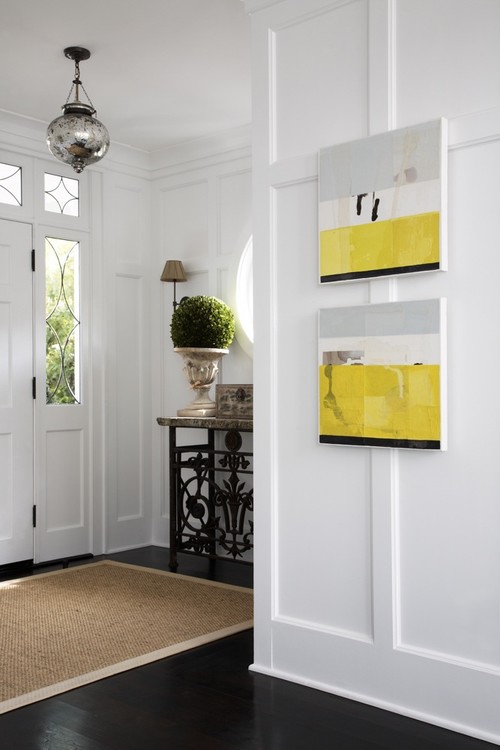
This overall cool entry is warmed up by the use of two beautiful art works. The yellow is like a beacon of warmth considering it is a cooler yellow.Did you notice the topiary tree used to bring the outside in and how it plays visually with the foliage outside the window?

If your  space faces south it will get warmer light and cooler colours will help to tone down the warmth. Personally I don't think a space can appear too warm especially in northern climates.  In east or west orientations you have a wide range of colour choices.

How does your entrance look these days? 


Senin, 24 Januari 2011

What I'm Loving

And have no business buying...

Coney Island Beach Print, in the largest size available!

This lampshade
This rug

Suzani placemats


Hello Mr. Owl, I know just where I'd put you...


This rug

Bourgie Lamp or two

A pretty mirror


Navy and white bedding. Perfect for spring...


A cozy throw


Jumat, 21 Januari 2011

Colouring outside the box with orange

Left to my own devices I would choose orange as either an accent or a main colour in decorating a home.  I am happy to see bits of orange in artwork, but that's as exciting as I can get about it.  To give orange a chance I decided to explore how others have used it to create stimulating decors.  Of course, no matter what you do with orange it will be vibrant and commanding. It is not a sit back colour!  I find  that people who love orange have personalities very like the colour. 


An orange sofa  begs to be noticed.  For most people furniture is a big ticket item, and cautiousness is often the ruling factor when purchasing  because you don't want to tire of it quickly.   I love the freshness of this room because it reminds me of eating melon on a tropical island. 

Is the wallpaper the accent wall or is it the orange wall? Circles and orange is about as energetic as you can get.  I love circular motifs.  How many circles are too many for you?


I like the way orange looks with gray.  But then again, I love gray with anything. You better love orange if you decide to put it on your cabinets.

Tineke triggs contemporary bedroom
tineke triggs


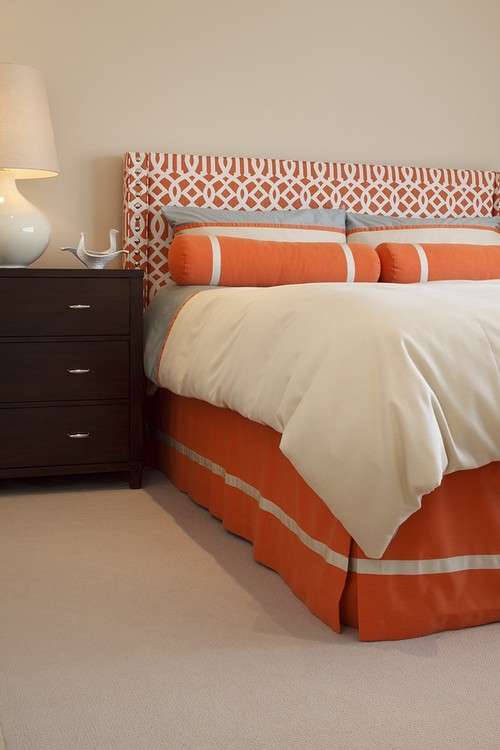
Freshness prevails when orange is used with beige and a bit of blue gray thrown in.


Astoria Guest Retreat eclectic bedroom
Domicile Interior Design

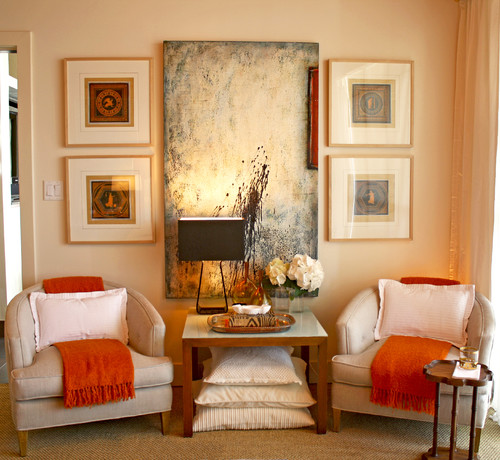
Just a little does the trick to liven up this very neutral space. 


source  

This is a funky colour on a very traditional piece of furniture but it works for me.   Accent pieces should have some energy to them.  

source

Purple and orange make a striking combination which works very well especially for a child's room.

source 

Take your cue from artwork when you want to add an accent colour in your decor.   

or ....

if you love orange just a little bit, let it  perform its magic in an artwork as it does in my dining  room .

Artwork by Carolyne Honey Harrison


Visit House Beautiful for a slide show of decorator's top picks for orange paint.